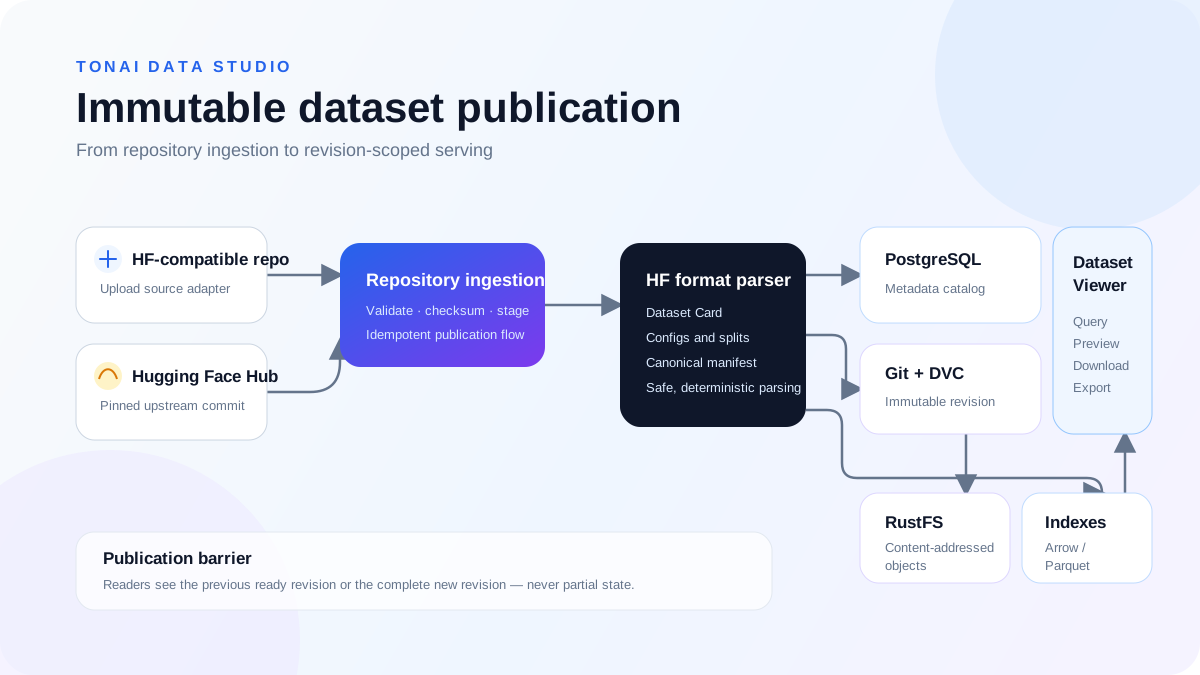
Production AI data platforms need more than a file upload endpoint. This specification defines a complete, reproducible path from Hugging Face-compatible repositories to immutable revisions, transactional metadata, content-addressed storage, columnar indexes, and revision-scoped serving.
View the source documentation on GitHub.
| Document attribute | Value |
|---|---|
| Status | Normative architecture specification |
| Intended audience | AI researchers and AI research engineering teams |
| Applies to | All production implementations of Data Studio |
| Primary concern | Repository ingestion, immutable revisioning, storage, indexing, and dataset serving |
1. Scope
This document specifies the target architecture and mandatory data lifecycle for Data Studio. It is the engineering baseline for design, implementation, testing, deployment, and operational review. It is independent of any prototype or incremental delivery plan.
Data Studio SHALL accept repositories that follow the common Hugging Face dataset repository contract. It SHALL preserve source content, create reproducible immutable revisions, maintain a transactional metadata catalog, and expose revision-scoped data through a Dataset Viewer and download APIs.
The specification covers:
- repository upload and Hugging Face Hub import;
- repository validation and Hugging Face layout parsing;
- PostgreSQL metadata and state management;
- Git and DVC revision creation;
- RustFS object storage;
- Arrow/Parquet index generation;
- dataset preview, query, download, export, retention, and recovery;
- consistency, security, observability, and acceptance requirements.
Full compatibility with every Hugging Face Hub network endpoint is outside the scope of this architecture. Repository-format compatibility is mandatory; protocol emulation is a separate concern.
1.1 Normative language
The terms SHALL, SHALL NOT, SHOULD, SHOULD NOT, and MAY define requirement strength:
- SHALL/SHALL NOT: mandatory for conformance;
- SHOULD/SHOULD NOT: expected unless an approved architecture decision records a justified exception;
- MAY: optional behavior that must not violate a mandatory requirement.
1.2 Definitions
| Term | Definition |
|---|---|
| Repository | A named dataset container identified by a stable internal ID and exposed as {namespace}/{dataset} |
| Source tree | The complete set of uploaded/imported files and their normalized relative paths |
| Revision | An immutable, published snapshot of one source tree and its parsed logical layout |
| Manifest | The canonical, checksummed description of all files and logical layout in a revision |
| Config | A named dataset configuration or subset |
| Split | A named partition such as train, validation, or test within a config |
| Source object | A byte-identical immutable copy of an input file |
| Derived artifact | A rebuildable output such as an index, schema, statistic, or thumbnail |
| Publication barrier | The final atomic operation that makes a complete revision visible to readers |
2. Reference architecture
flowchart TB
    HFRepo["HF-compatible repo"]
    HFHub["Hugging Face Hub"]
    Ingestion["Repository ingestion"]
    Parser["HF format parser"]
    PostgreSQL["PostgreSQL metadata"]
    GitDVC["Git + DVC revision"]
    RustFS["RustFS objects"]
    ArrowIndex["Arrow/Parquet index"]
    Viewer["Dataset Viewer"]

    HFRepo --> Ingestion
    HFHub --> Ingestion
    Ingestion --> Parser

    Parser --> PostgreSQL
    Parser --> GitDVC
    Parser --> ArrowIndex

    GitDVC --> RustFS
    ArrowIndex --> Viewer
The reference flow is:
HF-compatible repository ─┐
                          ├─> Repository ingestion ─> HF format parser
Hugging Face Hub ─────────┘                              │
                                                        ├─> PostgreSQL metadata
                                                        ├─> Git + DVC revision ─> RustFS objects
                                                        └─> Arrow/Parquet index ─> Dataset Viewer
The parser produces three coordinated outputs:
- Catalog plane — PostgreSQL records repository identity, access policy, revision state, file inventory, configs, splits, schema, statistics, and processing state.
- Version and content plane — Git records revision history and DVC pointers; DVC and RustFS store durable, content-addressed dataset objects.
- Serving plane — Arrow/Parquet artifacts provide revision-scoped, columnar access for the Dataset Viewer.
2.1 Architectural invariants
Every conforming implementation SHALL maintain the following invariants:
| ID | Invariant |
|---|---|
| ARC-001 | Source bytes and normalized relative paths are preserved without mutation. |
| ARC-002 | A published revision is immutable. Any content or layout change creates a new revision. |
| ARC-003 | Large source data is stored in RustFS, not PostgreSQL or Git. |
| ARC-004 | Git contains metadata and DVC pointers, not large dataset payloads. |
| ARC-005 | PostgreSQL never identifies a revision by a mutable object key. |
| ARC-006 | Every file in a published manifest resolves to an existing, checksum-valid source object. |
| ARC-007 | Every derived artifact is scoped to exactly one immutable source revision. |
| ARC-008 | A revision is invisible to normal readers until the publication barrier succeeds. |
| ARC-009 | Retrying the same request and source tree does not create duplicate revisions. |
| ARC-010 | Derived artifacts may be rebuilt without modifying the source revision. |
| ARC-011 | Uploaded code is never executed during ingestion, indexing, preview, or export. |
| ARC-012 | Permanent storage and database credentials are never exposed to the browser. |
3. Component responsibilities and contracts
3.1 Source adapters
The system SHALL support two logical source adapters:
- Upload adapter for a user-provided Hugging Face-compatible folder;
- Hub import adapter for a Hugging Face Hub repository resolved to an immutable upstream commit.
Both adapters SHALL produce the same internal input contract:
IngestionInput
├── repository_id
├── source_type: upload | hugging_face_hub
├── source_reference
├── resolved_source_commit (nullable for direct upload)
├── requested_parent_revision
├── commit_message
└── files[]
    ├── relative_path
    ├── staged_location
    └── received_size
An import from a moving upstream reference such as a branch SHALL resolve and persist the immutable upstream commit before processing begins.
3.2 Repository ingestion
Repository ingestion owns orchestration and the publication state machine. It SHALL:
- authenticate and authorize the request;
- allocate an upload/import session and idempotency key;
- stream source data into an isolated staging area;
- validate paths, limits, signatures, encoding, and declared file counts;
- compute source checksums;
- invoke the HF format parser;
- coordinate RustFS, DVC, Git, PostgreSQL, and indexing work;
- execute or compensate publication steps safely;
- persist progress, attempts, and structured errors.
Ingestion SHALL NOT make a revision visible by writing a branch or latest pointer before all
mandatory publication conditions are satisfied.
3.3 HF format parser
The parser SHALL be deterministic: identical source trees and parser versions SHALL produce the same normalized logical layout.
The parser SHALL:
- locate root
README.mdcase-sensitively; - decode it as UTF-8, allowing an optional byte-order mark;
- parse YAML front matter using a safe, non-executing loader;
- retain Dataset Card Markdown and produce sanitized HTML separately;
- resolve
configs,config_name,data_files, explicit split mappings, and glob patterns; - recognize conventional split aliases and sharded filenames when explicit declarations are absent;
- support Parquet, CSV, TSV, JSON, JSONL, TXT, ImageFolder, and declared media references;
- produce configs, splits, builder type, builder parameters, ordered file lists, and diagnostics;
- fail if an explicit path declaration matches no source file;
- never import or execute repository Python code.
Explicit Dataset Card declarations SHALL take precedence over heuristic detection. The parser SHALL record its schema/version identifier in the revision manifest.
3.4 PostgreSQL metadata catalog
PostgreSQL is the transactional authority for operational state, access control, and discoverability. It SHALL store metadata and object references only.
At minimum, the logical model SHALL contain:
| Entity | Required information |
|---|---|
| User / principal | Stable ID, identity attributes, authentication reference, status |
| Namespace | Stable ID, slug, owner type, access policy |
| Dataset repository | Stable ID, namespace, slug, owner, visibility, default branch, timestamps |
| Dataset revision | Repository, parent, revision ID, Git commit, DVC revision, manifest checksum/key, state, parser/index versions, creator, timestamps, error |
| Repository file | Revision, normalized path, byte size, SHA-256, media type, source object key, previewability |
| Dataset config | Revision, name, builder, normalized builder parameters |
| Dataset split | Config, name, ordered files, row/byte counts, schema/index/statistics references |
| Upload/import session | Repository, idempotency key, source, expected/received counts and bytes, state |
| Processing job | Repository, revision, type, state, progress, attempt count, timestamps, structured error |
| Branch/reference | Repository, name, current ready revision, update version |
Database constraints SHALL enforce repository-name uniqueness, revision uniqueness within a repository, unique paths within a revision, and unique config/split names within their parents.
3.5 Git and DVC revision service
The version service SHALL create an internal Git repository per dataset repository or an equivalent strongly isolated repository namespace.
Git SHALL record:
- the original Dataset Card source, its parsed metadata, and a separately sanitized render;
- the canonical manifest;
- DVC pointer files and DVC configuration that contains no credentials;
- revision metadata, parent relationship, and commit message.
DVC SHALL track the materialized source tree or its canonical content set and SHALL push all required objects to the RustFS S3-compatible remote before Git publication.
For each revision, the service SHALL persist:
RevisionBinding
├── revision_id
├── manifest_sha256
├── git_commit
├── dvc_revision
├── parent_revision_id
└── source_object_set_checksum
The binding is immutable. A verifier SHALL be able to prove that the Git tree, DVC object set,
manifest, and PostgreSQL file inventory describe the same revision.
source_object_set_checksum SHALL be calculated from the path-sorted sequence of
{path, size_bytes, sha256} tuples.
3.6 RustFS object storage
RustFS is the durable object store for:
- immutable source objects;
- DVC remote objects/cache;
- canonical manifests;
- Arrow/Parquet indexes;
- schemas, statistics, thumbnails, and other derived artifacts;
- optional revision exports;
- temporary staging objects when direct-to-object-storage upload is used.
Object writes SHALL use server-side credentials. Production buckets SHALL enable encryption, versioning or equivalent overwrite protection, lifecycle policies, access logging, and replication or backup appropriate to the recovery objectives.
3.7 Indexing service
Indexing SHALL run against immutable source objects only. A job SHALL receive a revision ID, parser version, and index-format version.
Using Arrow-compatible processing, the service SHALL:
- materialize each config/split from the manifest-defined ordered file list;
- infer and persist an explicit schema;
- calculate authoritative row counts where the source format permits;
- calculate byte counts and basic statistics;
- write partitioned Parquet or Arrow IPC artifacts;
- produce a bounded, sanitized preview;
- represent binary and media cells by typed references;
- write a checksummed index manifest;
- publish no index pointer until all required partitions are durable.
Schema coercion rules SHALL be deterministic and versioned. A schema conflict SHALL fail the affected index job with a structured diagnostic rather than silently dropping or converting data.
3.8 Dataset Viewer and download service
The Dataset Viewer SHALL resolve repository, revision, config, and split through PostgreSQL before querying an index. Query results SHALL remain bound to that revision for the complete request.
The serving layer SHALL support:
- column projection;
- bounded pagination or cursor-based traversal;
- typed filtering;
- schema and statistics retrieval;
- media reference resolution;
- exact source-file download;
- complete revision export.
The Viewer SHALL disclose whether statistics or rows are based on a bounded sample. It SHALL NOT represent sample-derived values as full-dataset results.
4. Canonical revision and manifest model
4.1 Repository path rules
A repository path SHALL:
- be a non-empty relative POSIX path;
- use
/as separator; - contain no
.or..segment; - contain no NUL or control character;
- contain no drive prefix, URI scheme, or leading
/; - resolve beneath the staging root;
- be unique after Unicode and separator normalization.
Symlinks, hard-link escapes, device files, sockets, and named pipes SHALL be rejected.
4.2 File identity
Every source file SHALL be described by:
{
  "path": "data/train-00000-of-00001.parquet",
  "size_bytes": 123456,
  "sha256": "64-lowercase-hex-characters",
  "media_type": "application/vnd.apache.parquet",
  "object_key": "datasets/source/acme/sentiment/<sha256>/data/train-00000-of-00001.parquet"
}
SHA-256 SHALL be calculated over the exact received bytes. Media type is descriptive and SHALL NOT replace signature or parser validation.
4.3 Canonical manifest
The manifest SHALL contain, at minimum:
{
  "manifest_version": 1,
  "repository_id": "stable-repository-id",
  "repository": "acme/sentiment",
  "parent_revision_id": "nullable-immutable-id",
  "source": {
    "type": "upload",
    "reference": null,
    "resolved_commit": null
  },
  "parser": {
    "name": "hf-format-parser",
    "version": "semantic-version"
  },
  "files": [],
  "configs": []
}
The manifest SHALL use deterministic UTF-8 JSON encoding, sorted object keys, stable list ordering, and no insignificant whitespace. File entries SHALL be ordered by normalized path. Configs SHALL be ordered by config name, splits by split name, and each split’s file list by normalized path.
Volatile values such as publication time, job ID, actor ID, and attempt number SHALL NOT participate in the canonical manifest hash.
4.4 Revision identity
The canonical revision identity SHALL be:
revision_id = "sha256:" + SHA256(canonical_manifest_bytes)A shorter display form MAY be used in the UI only when it is unambiguous within the repository. APIs, database relationships, manifests, branch pointers, and audit logs SHALL use the complete identity.
If the same canonical revision already exists, publication SHALL return the existing revision. Changing file bytes, file paths, parsed layout, parser version, or parent revision SHALL produce a different revision ID.
5. Standard ingestion and publication protocol
5.1 State machine
The normative revision-processing states are:
created
  → uploading/importing
  → validating
  → parsing
  → storing
  → versioning
  → indexing
  → publishing
  → ready
Any processing state MAY transition to failed. Cancellation before publishing MAY transition to
cancelled. ready, failed, and cancelled are terminal for that processing attempt. A retry is
recorded as a new attempt against the same idempotency key.
5.2 Protocol
Phase 1 — Authorize and reserve
- Authenticate the principal.
- Authorize write access to the target repository.
- Acquire a repository-scoped publication lease.
- Validate the requested parent against the current branch head.
- Create or recover the upload/import session by idempotency key.
Only one publication MAY update the same branch head at a time. Independent branches MAY be processed concurrently.
Phase 2 — Receive and stage
- Stream each file into
uploads/staging/{upload-id}/{relative-path}. - Enforce aggregate, per-file, file-count, rate, and temporary-storage limits while streaming.
- Persist received byte/file counters.
- Finalize only when the declared source set is complete.
Staged objects SHALL be private and SHALL NOT be served by dataset read APIs.
Phase 3 — Validate and parse
- Normalize and validate every repository path.
- Reconcile staged files with declared counts.
- Validate stable signatures and text encoding where applicable.
- Calculate file size, SHA-256, and media type.
- Parse the Dataset Card and logical HF layout.
- Produce validation diagnostics and the canonical manifest candidate.
No durable revision record SHALL be published if any mandatory validation fails.
Phase 4 — Store source objects
Each file SHALL be written idempotently to:
datasets/source/{namespace}/{dataset}/{sha256}/{relative-path}Before reusing an existing key, the storage adapter SHALL verify size and checksum. A conflicting object at the same immutable key is an integrity incident and SHALL stop publication.
Phase 5 — Create manifest, DVC revision, and Git commit
- Canonicalize the manifest and calculate
revision_id. - Return the existing revision if the ID is already published.
- Materialize the revision tree from verified source objects.
- Create DVC pointers and push all referenced DVC objects to RustFS.
- Verify remote object presence.
- Commit the Dataset Card, manifest, and DVC pointers to Git.
- Create an immutable Git ref for the revision.
- Persist the
RevisionBinding.
Git SHALL NOT reference DVC objects that have not been confirmed durable.
Phase 6 — Record metadata
In a transaction, write:
- the revision in
indexingstate; - the complete repository-file inventory;
- normalized configs and splits;
- Git, DVC, manifest, and source-object bindings;
- the indexing job and transactional outbox event.
The transaction SHALL be atomic. Worker dispatch SHALL use an outbox or equivalent mechanism so a committed revision cannot lose its indexing request.
Phase 7 — Build derived indexes
For every required config/split:
- read only manifest-referenced source objects;
- verify source size/checksum;
- build schema, row counts, statistics, preview, and partitions;
- write artifacts beneath the revision-scoped derived prefix;
- write and checksum the index manifest;
- atomically mark that config/split index complete.
One revision SHALL use one coherent index-format version. Partial output from a failed attempt SHALL not be referenced by readers.
Phase 8 — Publication barrier
Before changing a branch or latest pointer, the publisher SHALL verify:
- the manifest checksum and revision ID;
- existence and integrity of every required source object;
- DVC remote completeness;
- Git commit and immutable revision ref;
- PostgreSQL file/config/split completeness;
- completion and checksum of every mandatory index artifact;
- absence of a cancellation or authorization revocation that blocks publication.
The publisher SHALL then atomically:
- compare-and-swap the expected branch head;
- set the revision state to
ready; - update the branch/latest pointer;
- append an audit event.
Readers SHALL observe either the previous ready head or the new ready head, never an intermediate state.
Phase 9 — Finalize
After successful publication:
- release the publication lease;
- remove staging data according to policy;
- emit the revision-ready event;
- retain audit, manifest, Git, DVC, source, and derived records.
5.3 Idempotency and concurrency
- Every mutation request SHALL accept or generate an idempotency key.
- An idempotency key SHALL be scoped to principal, repository, operation, and normalized request.
- Reusing a key with different input SHALL return a conflict.
- Source-object writes, DVC pushes, manifest writes, and index writes SHALL be safe to retry.
- Branch updates SHALL use optimistic concurrency or an equivalent compare-and-swap operation.
- A stale-parent publication SHALL fail explicitly; it SHALL NOT silently rebase or overwrite.
5.4 Failure and compensation
| Failure point | Required behavior |
|---|---|
| Upload/validation | Mark attempt failed; expose structured error; retain staging only for bounded diagnosis |
| Source-object write | Retry safely; never publish incomplete manifest |
| DVC push | Keep Git ref unpublished; retry missing objects |
| Git commit/ref | Keep branch head unchanged; retain durable objects for retry/GC |
| Metadata transaction | Roll back transaction; do not dispatch an untracked job |
| Indexing | Keep revision non-ready; retry from immutable sources |
| Publication compare-and-swap | Mark conflict; do not overwrite newer head |
| Post-publication notification | Retry event delivery; do not revert a valid ready revision |
6. Storage layout and ownership
The following logical namespaces are normative. Separate buckets MAY replace prefixes if isolation, policy, and naming semantics remain equivalent.
uploads/
└── staging/{upload-id}/{relative-path}

datasets/
├── source/{namespace}/{dataset}/{sha256}/{relative-path}
├── manifests/{namespace}/{dataset}/{revision-id}/manifest.json
└── derived/{namespace}/{dataset}/{revision-id}/
    ├── index-manifest.json
    ├── indexes/{config}/{split}/part-{partition-id}.parquet
    ├── schemas/{config}/{split}.json
    ├── statistics/{config}/{split}.json
    └── thumbnails/{artifact-id}

dvc/
└── cache/{dvc-managed-object-layout}

exports/
└── {namespace}/{dataset}/{revision-id}/{export-id}/{artifact}
6.1 Authority by data class
| Data class | Authoritative representation | Rebuildable |
|---|---|---|
| Access policy and operational state | PostgreSQL | No; restore from database backup/audit log |
| Revision definition and lineage | Canonical manifest + Git revision binding | No |
| Source bytes | RustFS source objects + DVC integrity binding | No |
| File/config/split catalog | PostgreSQL, verifiable against manifest | Reconstructable, but operationally authoritative |
| Arrow/Parquet index | RustFS derived artifacts + index manifest | Yes |
| Preview, schema, statistics, thumbnails | Revision-scoped derived artifacts/catalog | Yes |
| Staging and export artifacts | RustFS temporary namespaces | Yes |
6.2 Storage rules
- Immutable namespaces SHALL deny overwrite after successful creation.
- All object writes SHALL carry or record a checksum.
- Multipart uploads SHALL be completed or aborted within a bounded time.
- Staging, derived, and export retention policies SHALL be independent.
- Object keys SHALL be treated as opaque server-side identifiers, not public permanent URLs.
- Presigned URLs SHALL be short-lived, scoped to one operation, and issued only after authorization.
- Renaming a repository SHALL NOT rewrite historical revision objects; stable repository IDs SHALL preserve ownership and lookup.
7. Query, download, and export protocols
7.1 Dataset Viewer query
- Resolve and authorize repository access.
- Resolve branch/tag aliases to one full immutable revision ID once per request.
- Resolve config/split and the complete index manifest in PostgreSQL.
- Verify index revision and format compatibility.
- Query only revision-scoped Arrow/Parquet partitions.
- enforce row, byte, execution-time, and result-size limits;
- return the resolved revision ID with every response.
Paging tokens SHALL encode or bind the revision ID. A token from one revision SHALL NOT be accepted for another revision.
7.2 Original-file download
The service SHALL resolve {repository, revision_id, relative_path} to exactly one manifest file
entry, authorize the caller, and stream the corresponding source object. Response metadata SHOULD
include size, media type, ETag/checksum, and immutable revision identity.
Range requests and short-lived presigned downloads MAY be supported. Authorization SHALL occur before URL issuance, and private object keys SHALL not be enumerable.
7.3 Revision export
An export SHALL:
- be bound to a complete immutable revision ID;
- read files in manifest path order;
- preserve relative paths and source bytes;
- include the Dataset Card and manifest;
- exclude derived artifacts unless explicitly requested;
- produce and publish an export checksum;
- expire according to the export retention policy.
8. Lifecycle, deletion, and disaster recovery
8.1 Revision lifecycle
A ready revision SHALL never be modified. Re-indexing creates a new derived-artifact generation bound to the same revision and a new index-format version; it does not create a source revision.
8.2 Deletion
Repository or revision deletion SHALL be a two-stage operation:
- create a tombstone and remove user-visible references according to authorization and retention policy;
- physically delete unreferenced objects only after the recovery window and a complete reference scan.
Garbage collection SHALL use mark-and-sweep across PostgreSQL, Git refs, manifests, DVC metadata, active jobs, legal holds, and retained exports. Prefix age alone SHALL NOT determine that an immutable object is unreferenced.
8.3 Backup and recovery
Backups SHALL cover PostgreSQL, internal Git repositories, RustFS source/manifests/DVC objects, and required encryption keys. Derived indexes MAY be excluded only when rebuild time meets the recovery objective.
Recovery order SHALL be:
- restore identity/access data and PostgreSQL;
- restore Git and canonical manifests;
- restore RustFS source and DVC objects;
- verify revision bindings and checksums;
- rebuild missing derived indexes;
- enable read traffic;
- enable write/publication traffic.
Recovery tests SHALL verify at least one complete revision from catalog lookup through byte-identical download and Viewer query.
9. Security requirements
- All repository content SHALL be treated as untrusted.
- Uploaded Python or executable content SHALL be stored only as opaque bytes and SHALL never run.
- Archive extraction SHALL reject traversal, absolute paths, links, device files, and expansion beyond configured limits.
- MIME declarations SHALL not be trusted without relevant signature/parser validation.
- Dataset Card YAML SHALL use a safe loader; rendered Markdown SHALL be sanitized.
- Ingestion and indexing workers SHALL run with least privilege and enforced CPU, memory, time, and temporary-storage limits.
- Service identities SHALL use separate credentials for PostgreSQL, source storage, DVC, Git, and derived storage where practicable.
- Encryption SHALL be enabled in transit and at rest.
- Logs SHALL exclude credentials, access tokens, presigned URLs, and raw sensitive dataset rows.
- Authorization SHALL be enforced for metadata, indexes, source objects, exports, and job status.
- Audit records SHALL cover authentication-sensitive mutations, repository access-policy changes, publication, deletion, token issuance, and administrative recovery actions.
10. Observability and operational requirements
Every ingestion attempt SHALL have a correlation ID, upload/import ID, repository ID, job ID, and, after canonicalization, revision ID.
Implementations SHALL expose:
- state-transition counters and duration histograms;
- staged/source/derived byte and object counts;
- checksum and integrity failures;
- DVC push and Git publication latency;
- indexing throughput, partition count, and failure rate;
- publication-barrier latency and compare-and-swap conflicts;
- Viewer latency, rows/bytes scanned, and limit rejections;
- staging leaks, orphan candidates, and garbage-collection results.
Alerts SHALL distinguish availability failures, data-integrity failures, authorization failures, capacity exhaustion, and expected user validation errors. Data-integrity failures SHALL receive the highest operational severity.
11. Conformance and acceptance criteria
An implementation conforms to this specification only if automated tests demonstrate:
- byte-identical upload/import and download for every supported source format;
- preservation of nested relative paths and rejection of unsafe paths;
- deterministic parsing and manifest generation;
- deterministic revision identity and idempotent retry;
- correct config, split, shard, and Dataset Card resolution;
- DVC remote completeness before Git publication;
- no visibility of a partially indexed or partially committed revision;
- compare-and-swap protection against concurrent branch updates;
- checksum detection for corrupted source, manifest, and index objects;
- revision-isolated Viewer queries and paging;
- rebuild of all derived artifacts from immutable source objects;
- authorization enforcement across metadata, Viewer, download, export, and mutation paths;
- safe failure and recovery at every publication phase;
- backup restoration followed by byte-identical download and valid Viewer query;
- garbage collection that preserves every referenced revision and shared content object.
These requirements define the standard Data Studio architecture. Deviations require a reviewed architecture decision and SHALL preserve all architectural invariants in Section 2.1.
12. User usage examples
This section is informative. It illustrates the expected experience for an AI Researcher; the normative architecture and integrity requirements in the preceding sections remain authoritative.
12.1 Example research dataset
The examples use a table-understanding dataset named table-html-reasoning-v2. It pairs rendered
table images with source HTML and deterministic logical-structure reasoning labels.
The source workspace contains:
table-html-reasoning-v2/
├── README.md
├── metadata.json
├── hf_parquet/
│   ├── train-00000-of-00006.parquet
│   ├── train-00001-of-00006.parquet
│   ├── ...
│   ├── train-00005-of-00006.parquet
│   └── test-00000-of-00001.parquet
├── images/
│   └── 31,490 PNG table images
├── table_html/
│   └── 31,490 HTML labels
└── table_html_reasoning/
    └── 31,490 JSON reasoning labels
The published dataset has the following expected split:
| Split | Samples | Purpose |
|---|---|---|
train | 28,341 | Model training and development |
test | 3,149 | Held-out evaluation |
| Total | 31,490 |
Each published row contains:
| Column | Meaning |
|---|---|
id | Stable sample identifier |
images | One or more rendered table images |
table_html | Source table HTML |
reasoning | JSON-encoded logical table reasoning label |
num_rows, num_cols, num_cells | Structural dimensions |
has_merged_cells | Whether the table contains rowspan or colspan |
validation_passed | Result of deterministic structural validation |
num_images | Number of images associated with the sample |
12.2 Prepare the repository for publication
The researcher SHOULD place a Dataset Card at the upload root and explicitly declare the Parquet shards. An explicit declaration makes config/split resolution deterministic and avoids dependence on filename heuristics.
Example README.md front matter:
---
license: other
task_categories:
  - image-to-text
  - visual-question-answering
language:
  - en
size_categories:
  - 10K<n<100K
pretty_name: Table HTML with Logical Reasoning
configs:
  - config_name: default
    data_files:
      - split: train
        path: hf_parquet/train-*.parquet
      - split: test
        path: hf_parquet/test-*.parquet
---
The Dataset Card SHOULD also document:
- dataset purpose and intended model tasks;
- source and license information;
- split construction and leakage controls;
- column definitions;
- reasoning-label schema version;
- known validation failures and limitations;
- the procedure used to generate the labels.
Before upload, the researcher SHOULD verify:
- every relative path uses
/and resolves beneath the repository root; - every Parquet shard opens successfully;
- image or auxiliary-file references resolve to files inside the repository;
- sample IDs are stable and unique;
- the split counts equal 28,341 training rows and 3,149 test rows;
- no credential, local absolute path, temporary file, or generated cache is included.
12.3 Publish the dataset through the web application
-
Open TonAI Data Studio and sign in.
-
Select New dataset.
-
Use a repository identity such as:
Namespace: research Dataset: table-html-reasoning-v2 Visibility: Internal Description: Table images, HTML, and deterministic logical-structure reasoning labels -
Open the repository and select Upload revision.
-
Select the
table-html-reasoning-v2/folder. The selected root SHALL containREADME.md. -
Enter a descriptive commit message, for example:
Publish v2 with deterministic train/test split and logical reasoning labels -
Start publication and keep the upload session open until all source files have been accepted.
-
Wait for the revision state to become
ready. -
Record the full revision ID shown by Data Studio.
The researcher SHOULD expect the published revision to expose:
- config
default; - splits
trainandtest; - 28,341 and 3,149 rows respectively;
- the Dataset Card, repository file tree, schema, statistics, preview, and revision history.
A mismatch in split count, missing shard, unresolved image, or invalid explicit data_files pattern
SHALL be treated as a failed publication, not accepted as a partial dataset.
12.4 Inspect and validate the published revision
The researcher SHOULD perform the following checks before using the revision in an experiment:
Dataset Card and revision
- confirm the title, tasks, language, license, sources, and limitations;
- confirm the displayed revision ID and publication message;
- verify that the file tree contains all seven Parquet shards and required auxiliary assets.
Schema and split counts
- open config
default; - compare the
trainandtestrow counts with the expected values; - verify that structural columns use numeric/boolean types;
- verify that
images,table_html, andreasoningare present.
Visual and structural review
- open representative rows and compare the rendered image with
table_html; - filter
has_merged_cells = trueto inspectrowspan/colspanexamples; - filter
validation_passed = falseto audit preserved source irregularities; - inspect samples from each source family rather than only the first page;
- download at least one source object and verify its checksum when performing a release audit.
The reasoning field is a JSON string. A decoded record is expected to include
schema_version, table_shape, cells, logical_grid, relations, reasoning_trace, and
validation. A region containing multiple top-level tables MAY decode to a list of reasoning
records.
12.5 Use a pinned revision in an experiment
An experiment SHALL record the full Data Studio revision ID rather than a moving alias such as
main or latest. It SHOULD also record the manifest and export checksums.
Example experiment configuration:
dataset:
  repository: research/table-html-reasoning-v2
  revision: sha256:<full-canonical-revision-hash>
  config: default
  train_split: train
  evaluation_split: test
  manifest_sha256: <manifest-checksum>
  export_sha256: <optional-export-checksum>
After downloading and extracting a complete revision export to
./table-html-reasoning-v2, the Parquet files can be loaded without executing repository code:
import json

from datasets import load_dataset

data_files = {
    "train": "./table-html-reasoning-v2/hf_parquet/train-*.parquet",
    "test": "./table-html-reasoning-v2/hf_parquet/test-*.parquet",
}
dataset = load_dataset("parquet", data_files=data_files)

assert dataset["train"].num_rows == 28_341
assert dataset["test"].num_rows == 3_149

sample = dataset["train"][0]
decoded = json.loads(sample["reasoning"])
reasoning_records = decoded if isinstance(decoded, list) else [decoded]

print(sample["id"])
print(reasoning_records[0]["table_shape"])
print(reasoning_records[0]["logical_grid"][0])
The experiment record SHOULD additionally contain the training code commit, model configuration, random seed, and Data Studio revision ID. This is the minimum linkage required to reproduce which dataset bytes were used.
12.6 Publish a follow-up revision
When labels, HTML, images, or split assignments change, the researcher SHALL publish a child revision rather than replacing an existing ready revision.
The recommended workflow is:
- start from the exact parent revision used to prepare the change;
- update source files and the Dataset Card;
- document schema or generation changes in the commit message;
- upload the complete repository tree;
- verify the expected parent revision before publication;
- repeat the Card, schema, split-count, visual, and validation checks;
- record the new full revision ID in subsequent experiment configurations.
Previously completed experiments remain pinned to the earlier revision. This permits direct comparison between model results without ambiguity about dataset content.