A small API change can break a client without changing the extracted data. Suppose
an invoice service returns a fields object and a developer asks a coding agent to
add confidence scores. The agent might add confidence: null to every response,
coerce the string "false" into a boolean, or move extraction rules into an HTTP
handler. A happy-path test could pass while each of those decisions violates a
requirement.
In this post, I use a small invoice-extraction project to turn that situation into a concrete engineering exercise. The example contains a deterministic Python service, a frozen version before the feature, checks that run without network access after setup, and a prepared comparison of three repository configurations. The feature uses rule-based presence/validity scores, not calibrated probabilities, model certainty, or measured extraction accuracy. A valid-looking value can still be wrong for the invoice a person intended.
The goal is to show how repository guidance, executable checks, and a repeatable review process fit together around a coding agent—and how to evaluate their contribution without overstating the evidence.
Explore the example project on GitHub: example-harness-codex.
Experiment status: the implementation and evaluator have local verification evidence. The A/B/C agent trials have not been run, so there are no timing, cost, token, or success-rate comparisons to report.
All paths and commands below are relative to the root of example-harness-codex.
Source links open the corresponding files in that repository.
1. Prompt, context, and harness engineering
These are practical working definitions rather than a universal taxonomy:
| Concern | Main question | Example here |
|---|---|---|
| Prompt engineering | What task are we asking for? | Specify strict booleans and legacy response compatibility. |
| Context engineering | What information should be available, and where? | Put layer boundaries in a short architecture document. |
| Harness engineering | How is work executed, checked, and corrected? | Run fixed tests and inspect failures within bounded repairs. |
The categories overlap. A prompt can tell the agent which checks to run, and a check failure becomes context for its next decision. A skill packages procedural context, while its commands invoke executable feedback. Naming the categories is useful when it helps identify a missing mechanism. It is less useful when every additional instruction gets called an improvement without evidence.
For example, “preserve compatibility” is reasonable task wording, but ambiguous until an expected response is written down. A regression test makes that expectation observable for the examples it covers. An architecture guide explains where a change belongs; an import checker detects some violations. Neither proves that all future changes will be correct. Extra rules also consume attention and need maintenance, so the appropriate amount of guidance is an empirical question.
2. Where the Codex runtime ends and repository guidance begins
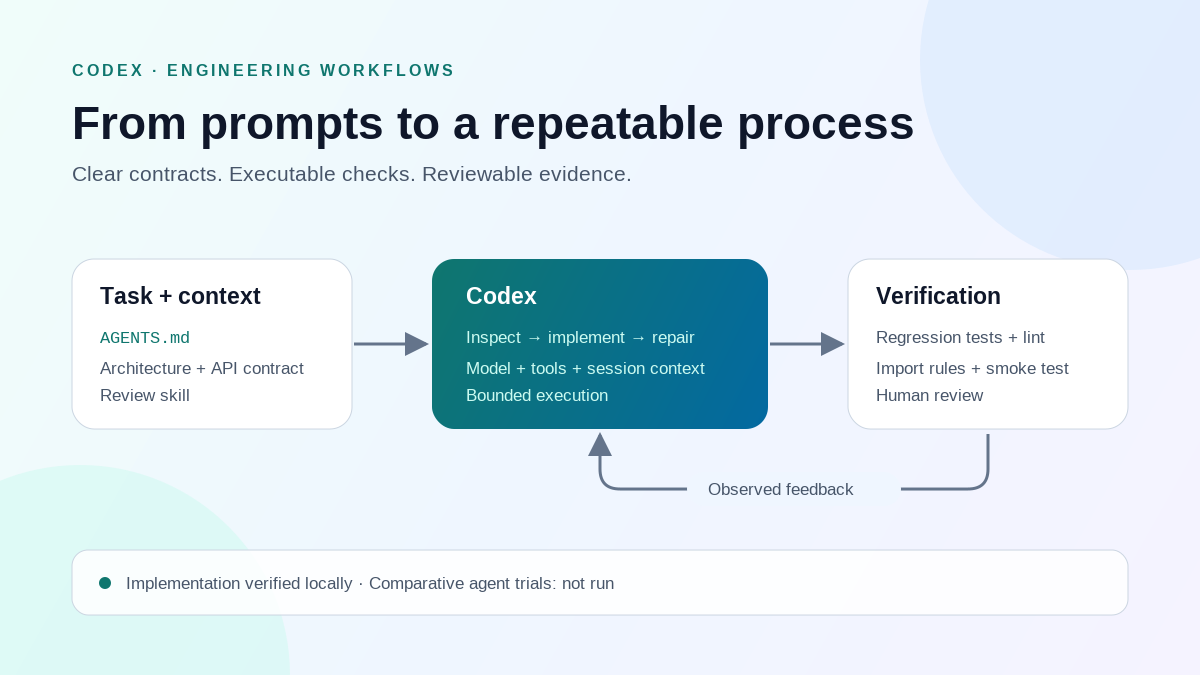
A language model proposes actions and code. Codex supplies a surrounding runtime for context, tools, execution, and configured operational boundaries. OpenAI’s description of the Codex harness explains that surrounding system. The example adds repository practices inside that runtime; it does not implement a replacement coding-agent runtime.
The following is a conceptual diagram, not a trace of a measured trial:
flowchart TB
    Person[Engineer and task] --> Runtime
    subgraph Runtime[Codex runtime harness]
        Model[Model] <--> Context[Session context]
        Model <--> Tools[Tool execution]
        Controls[Configured permissions and approvals] --> Tools
    end
    Repo[Repository guidance and skill] --> Context
    Tools --> Code[Application changes]
    Code --> Checks[Tests, lint, import check, smoke]
    Checks --> Context
    Person --> Review[Human review and completion decision]
    Checks --> Review
Even the baseline arm uses Codex and its normal tools and safety controls. Calling it baseline means fewer repository additions. It does not mean a bare model with no runtime harness. This distinction prevents a misleading claim that a repository shell script is responsible for capabilities already supplied by the coding environment.
3. A small service with a precise contract
The service accepts a JSON request whose text field contains four labeled lines: Invoice Number,
Date, Total, and Currency. Labels match case-insensitively at the start of a
line, with surrounding whitespace and a colon. Unrelated lines are ignored. For
each field, the first valid matching line wins; an invalid first occurrence does
not block a later valid one.
Invoice numbers use a limited ASCII grammar. Dates must be actual calendar dates
in YYYY-MM-DD form. Totals accept nonnegative ASCII decimals with at most two
fractional digits; Decimal produces a two-decimal string. Exponents, commas,
signs, and Unicode decimal digits are rejected. Currency accepts exactly three
ASCII letters and returns uppercase. Missing or invalid fields become JSON null,
with all four keys retained.
This scope makes the rules inspectable. It also creates a strict limit on what success means. The service does not read PDFs, upload files, run OCR or LLM inference, manage queues, authenticate users, provision cloud infrastructure, or deploy anything. It has no GPU requirement, model download, API key, or database. Only synthetic documents belong in the fixtures. There is no claim of reliable extraction from arbitrary invoices.
Document text is data. A line that says to execute a command or fetch a URL has no authority. The implementation neither evaluates content nor uses it as a path or network destination. Application code does not log document contents. These are properties readers can inspect and test, rather than assumptions that an instruction-like document will always be harmless in a different application.
4. Organizing guidance and checks
The example separates the application, guidance, checks, and experiment setup. Short trial instructions live in overlays so agents receive only their assigned feature task. The compact tree below omits caches and generated environments:
AGENTS.md
pyproject.toml, uv.lock, .python-version
.agents/skills/api-review/SKILL.md
src/document_extraction/
  main.py
  api/routes.py
  schemas/contracts.py
  services/extraction.py
  inference/rules.py
tests/{unit,integration,fixtures}/
scripts/{check.sh,check_architecture.py,smoke.py}
docs/{architecture.md,conventions.md,implementation-log.md}
experiments/
  starter/, overlays/{B,C}/, evaluator/
  tasks/confidence.md, protocol.json, manifests.json
  scripts/{prepare_trial.py,evaluate_trial.py,summarize.py}
  results/{README.md,runs.jsonl,summary.md}
Codex recognizes AGENTS.md as an instruction mechanism, with inherited guidance
also relevant; see the official
custom-instructions documentation.
The experiments/overlays/B/AGENTS.md instructions specify purpose,
compatibility, boundaries, verification commands, and completion evidence. They
require reading the architecture document when changing boundaries and stay
below 100 lines to keep the guidance focused.
Repository skills use .agents/skills/<name>/SKILL.md, with a name and description
in YAML front matter. The official
skill documentation describes
repository discovery, progressive loading, and invocation. Here the
API review skill at .agents/skills/api-review/SKILL.md asks for diff inspection,
old/new JSON comparison, input review, manual boundary inspection, and actual
check results. A reader can explicitly request it with $api-review.
Discovery is not evidence of use, and instructions do not enforce every sentence they contain. The runtime may make skills available without invoking a particular one. The example implementation was built with an explicit skill review; future trials must record observed use separately. The review procedure is a project choice.
Other paths have no implied automatic behavior. docs/architecture.md becomes
useful when referenced or read. scripts/check.sh runs only when invoked. Keeping
that distinction explicit prevents a documentation folder from being mistaken
for an execution control.
5. Making architecture boundaries observable
The architecture guide in docs/architecture.md specifies HTTP API → service →
deterministic extractor, with shared schema types. The composition root explicitly
creates the app and includes the router. Routes validate, delegate, and serialize.
The service imports no FastAPI, Starlette, or API modules. The extractor imports
no HTTP or service modules. Schemas have no upward dependencies.
The AST checker in scripts/check_architecture.py walks static imports under
one selected source package, including relative imports. Violations produce file
and line diagnostics and a nonzero status. Its unit fixtures exercise allowed
and forbidden edges, including from .. import api. Selecting one candidate
package avoids accidentally checking every frozen snapshot in the experiment
folder.
Static imports are a useful but incomplete oracle. They do not establish that a route contains no parsing logic, detect every dynamic import, or prove business correctness. The review skill therefore also inspects route delegation manually. Pydantic result types are used across layers without importing the HTTP framework; there is no pretend machine-learning abstraction around the regex rules.
6. Adding optional scores without breaking clients
Before the feature, this request returns only fields:
{
  "text": "Invoice Number: INV-001\nDate: 2026-01-15\nTotal: 123.45\nCurrency: usd"
}
{
"fields": {
"invoice_number": "INV-001",
"date": "2026-01-15",
"total": "123.45",
"currency": "USD"
}
}The feature adds include_confidence, a strict boolean with default false.
Omission and false preserve that response exactly. True adds a top-level object
with the same four field names and scores of 1.0 for valid values or 0.0 for null.
These numbers are only rule-based presence/validity indicators; a schema-valid
invoice number does not establish that it belongs to the intended document.
The compatibility contract is small enough to summarize before looking at code:
include_confidence input | Expected behavior |
|---|---|
Omitted or false | Return only fields, including null values for missing fields. |
true | Return fields and a confidence object with the same four keys. |
"true", "false", 0, or 1 | Reject with HTTP 422; do not coerce the value. |
The following function is copied from the final
service in src/document_extraction/services/extraction.py:
def extract_document(text: str, include_confidence: bool = False) -> ExtractResponse:
    fields = extract(text)
    if include_confidence:
        scores = {
            key: 1.0 if value is not None else 0.0
            for key, value in fields.model_dump().items()
        }
        return ExtractResponse(fields=fields, confidence=Confidence(**scores))
    return ExtractResponse(fields=fields)
The request schema in src/document_extraction/schemas/contracts.py uses
StrictBool and StrictStr, forbids unknown properties, and checks original text
length before rejecting whitespace-only content. An integer flag or the string
"true" returns 422. Text over 10,000 characters is rejected even if trimming
would make it short. Malformed JSON also returns 422.
Serialization needs care: the response model has an optional confidence field,
but default legacy responses must omit that field. The
route in src/document_extraction/api/routes.py uses
response_model_exclude_unset=True. The service explicitly supplies confidence
only when requested. Extracted fields are explicitly populated, including nulls,
so preserving their keys does not depend on a blanket exclusion of null values.
The regression suite verifies the resulting JSON rather than merely inspecting
which model option was selected.
7. Building a verification and repair loop
From a clean checkout, install using uv sync --locked --group dev, then run
bash scripts/check.sh. The committed lock comes from the resolver, not manually
selected package versions. The official
uv project workflow explains its
project environment and lock mechanisms. The tested interpreter is Python 3.12.3;
docs/environment.json records actual resolved versions and OS.
The verification commands are copied from scripts/check.sh:
uv run --locked --offline ruff check .
uv run --locked --offline ruff format --check .
uv run --locked --offline pytest -q
uv run --locked --offline python scripts/check_architecture.py
uv run --locked --offline python scripts/smoke.py
The wrapper changes reliably to the repository root and exits on failure. It
never formats or autofixes files. Explicit repair commands are separate, allowing
a reviewer to distinguish observing a failure from changing the candidate.
Ruff supplies lint and formatting checks;
pytest supports explicit test
selection. Default test discovery stays under tests, so frozen and evaluator
suites do not accidentally join the ordinary run.
The smoke script uses TestClient in process, following the approach documented by
FastAPI. It needs no server or
network connection. For manual exploration, the README binds Uvicorn to
127.0.0.1; exposing this teaching service publicly is outside scope.
This second diagram describes the intended feedback procedure:
flowchart TD
    Inspect[Inspect task, contracts, boundaries] --> Implement[Implement a small change]
    Implement --> Targeted[Run affected checks]
    Targeted --> Decision{Checks pass?}
    Decision -->|yes| Full[Run complete check script]
    Full --> Review[Review diff and evidence]
    Decision -->|no| Limit{Three consecutive failed repairs?}
    Limit -->|no| Repair[Repair against observed failure]
    Repair --> Targeted
    Limit -->|yes| Stop[Stop repairs, preserve evidence, report blocker]
    Review --> Done[Report verified outcome and limitations]
The implementation log records actual setup and repair events: lint failures
from long lines, explicit fixes followed by reruns, and a bootstrap failure when
Python’s ensurepip was unavailable. A project-local uv installation resolved the
setup issue. These are construction observations, not A/B/C agent results.
The tests cover exact legacy response shape, optional scores, invalid flag types, complete/missing/invalid/duplicate fields, Unicode, calendar dates, decimal grammar, original length boundaries, unknown properties, malformed JSON, deterministic repetition, instruction-like text, and document-content logging. Hand-reviewed synthetic fixtures make expected outputs visible. The verified environment emitted an HTTPX TestClient deprecation warning from Starlette; the implementation log records it alongside the retained dependency stack.
8. Preparing an A/B/C comparison
The experiment protocol in experiments/README.md defines three inputs:
| Arm | Agent-visible additions | Execution status |
|---|---|---|
| A | Frozen application, ordinary README, public tests and common prompt | Not run |
| B | A plus concise AGENTS.md and architecture guide | Not run |
| C | B plus review skill, checks and feedback workflow | Not run |
The starter was checked before the confidence implementation. SHA-256 manifests freeze its source, lock, tests, prompt, evaluator, scoring rules and overlays. Preparation copies starter plus the chosen overlay and verifies common hashes. It refuses nonempty destinations and trial paths inside this construction tree. No final solution or evaluator-only case is copied into a trial workspace.
The evaluator self-check on the starter passed regressions and failed all four
designated feature assertions for the expected reason. The same evaluator passed
all 49 cases on the final implementation. These are local evaluator self-checks,
not agent trials. Evidence resides in docs/starter-evaluator.json
and docs/final-evaluator.json. The results ledger is empty,
and its generated summary explicitly says “Not run.” There is no results chart.
Candidate evaluation uses a disposable copy and its own environment installed from the candidate lock. It verifies module provenance before running fixed external tests; accidentally importing this final example cannot count as success. Changed protected public tests, dependency settings, or present C check scripts are rejected. Collection failures and missing dependencies cannot satisfy the expected starter feature failure. The original candidate is not repaired during scoring.
9. Measuring outcomes and accounting for confounds
An authorized experiment would use fresh sessions outside the example repository and its ancestors, identical prompts, three repetitions per arm, and the frozen order A/B/C, B/C/A, C/A/B. Each run gets fifteen minutes and at most three repairs. An operator must record limits that the runtime cannot enforce or observe reliably. Setup time is separate from task time. Failures and timeouts remain in denominators.
Exact model, reasoning setting, runtime version, permissions, network policy, tools and hardware must be held fixed and recorded. Some execution settings remain unresolved in the prepared protocol; no trial should claim control over unknown settings. The protocol records a manual fresh-session procedure; preparing it did not launch a paid agent call.
A fresh directory is not sufficient isolation. Inherited instructions, user skills, plugins, memories and configuration can affect all arms. A profile can layer configuration without removing those sources. Likewise, an evaluator in another directory is not hidden when the agent can read the filesystem. The prepared example has established neither a private evaluator barrier nor fully isolated runtime guidance. Future runs must enforce those properties or label the resulting confounds and call tests agent-visible.
Functional correctness and architecture are reported separately, then combined. Manual review checks route delegation, forbidden imports, unrelated changes and test weakening against a fixed rubric, recording reviewer identity and blinding. Observable interventions and permission prompts are recorded separately. A human hint does not disappear into elapsed time; the unassisted outcome must be saved. Post-evaluation repair is a new demonstration rather than another scored attempt.
The summarizer validates records and rejects duplicates. Unavailable usage is null with a reason, never zero. It retains unsuccessful attempts and lists missing data and exclusions. Monetary comparisons require actual usage and dated cited rates; this project has neither trial usage nor a cost claim. Even nine completed runs on this one task would not establish statistical significance, general superiority, or production safety. C changes a bundle, so any difference could not be assigned to the skill or instruction file alone.
10. Applying the pattern in your own repository
Start with one fragile compatibility requirement and a concrete expected output. Keep a small architecture guide close to the code. Add a check only when its failure tells an engineer something actionable. Use a skill for a review procedure that benefits from repetition, and distinguish manual judgments from executable constraints. Preserve a pre-change snapshot before making comparative claims.
Every mechanism carries maintenance cost. Fixtures can encode a mistaken contract; a weak oracle can reward the wrong implementation. Import rules can become stale as boundaries change. Long instructions can distract from a narrow task. An agent can run an inappropriate command if permissions and human oversight are treated as documentation alone. More autonomous execution should stay within the task’s actual authorization, with explicit stopping conditions and evidence preservation.
This example establishes an inspectable local implementation and a prepared measurement procedure. It does not establish that the additional harness improves Codex outcomes. The service and checks can be evaluated independently of agent trials. A useful next step is to run the frozen comparison under controlled conditions and report every attempt, including failures. Until then, the honest experimental result remains “Not run.”